

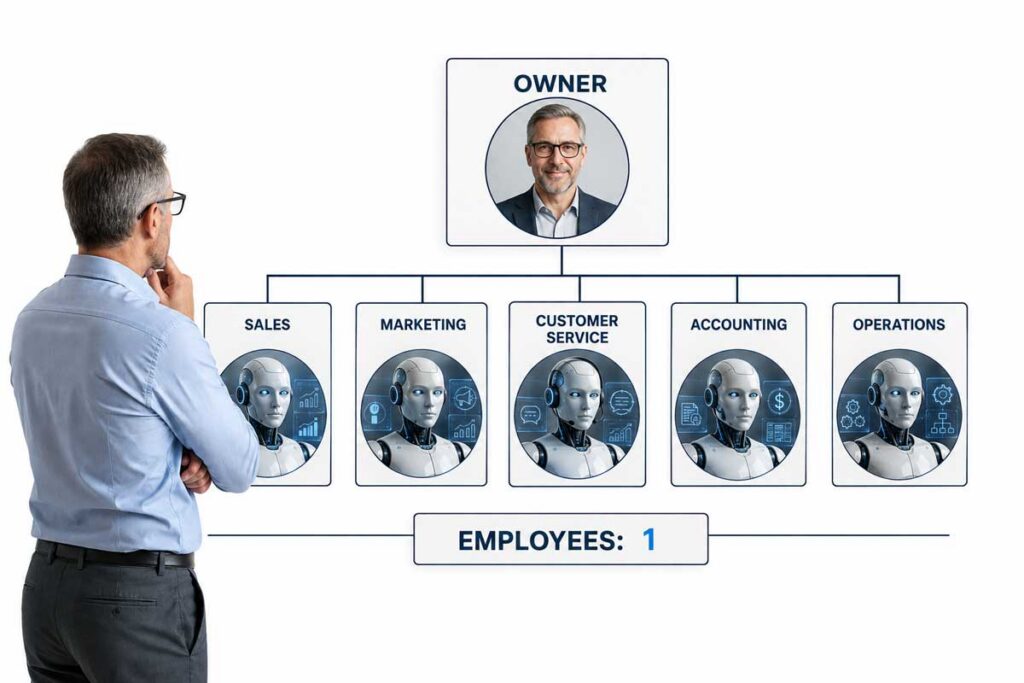
AI isn’t just impacting jobs. AI is changing ownership.
Headlines treat AI as something coming for your job. The same data can be read another way: the barrier to business ownership has dropped further, and faster, than most people realize.
I’ll cover this in a September 17th webinar — details below!
Something genuinely remarkable is happening, and it’s worth looking at directly before deciding what it means for you.
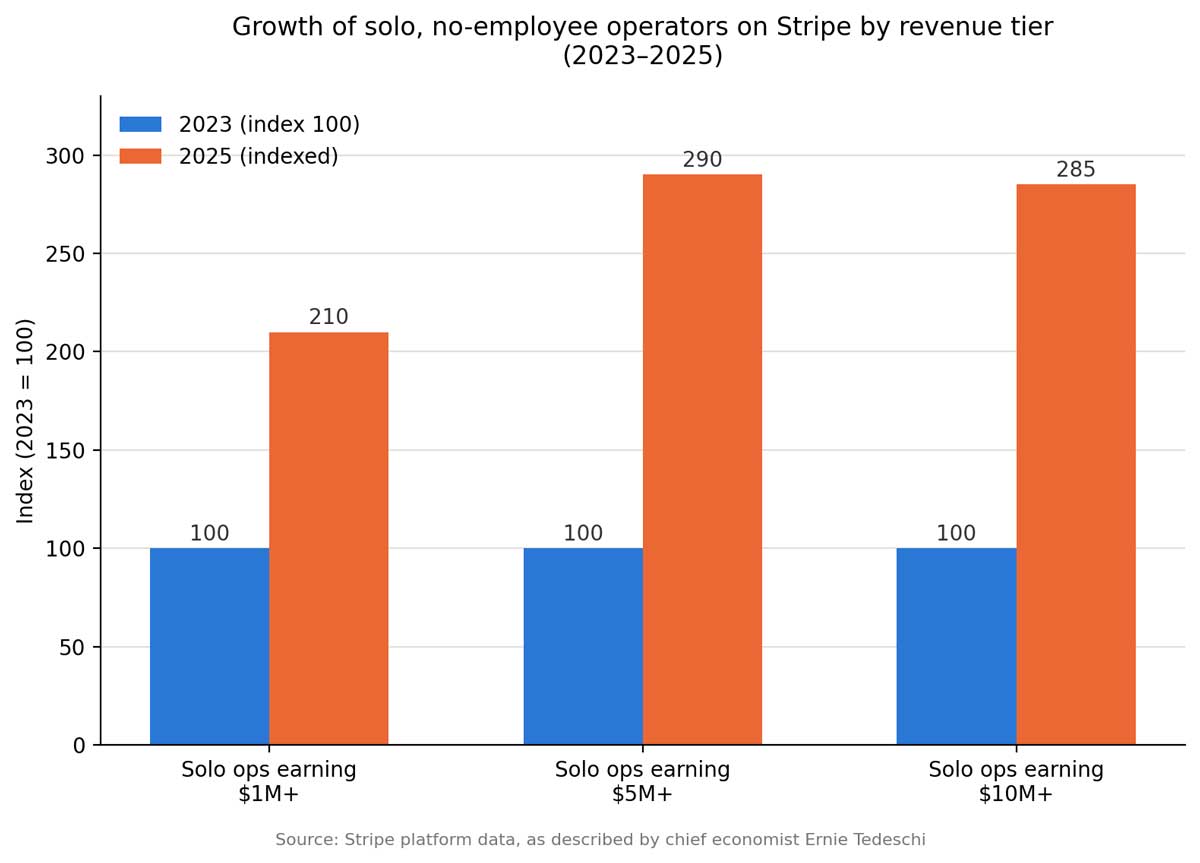
An analysis by the payments company Stripe found thousands of solo operators on its platform generating more than $1 million in revenue — with no employees at all. That million-dollar group more than doubled between 2023 and 2025. The number clearing $5 million and $10 million nearly tripled over the same stretch. Stripe’s chief economist, Ernie Tedeschi, describes the shift simply: AI can now act as a built-in business partner, handling work that used to require hiring someone.
Before Continuing – An Announcement:
Next month, I’ll be conducting a Webinar to discuss this topic within the broader subject of Franchising 101:
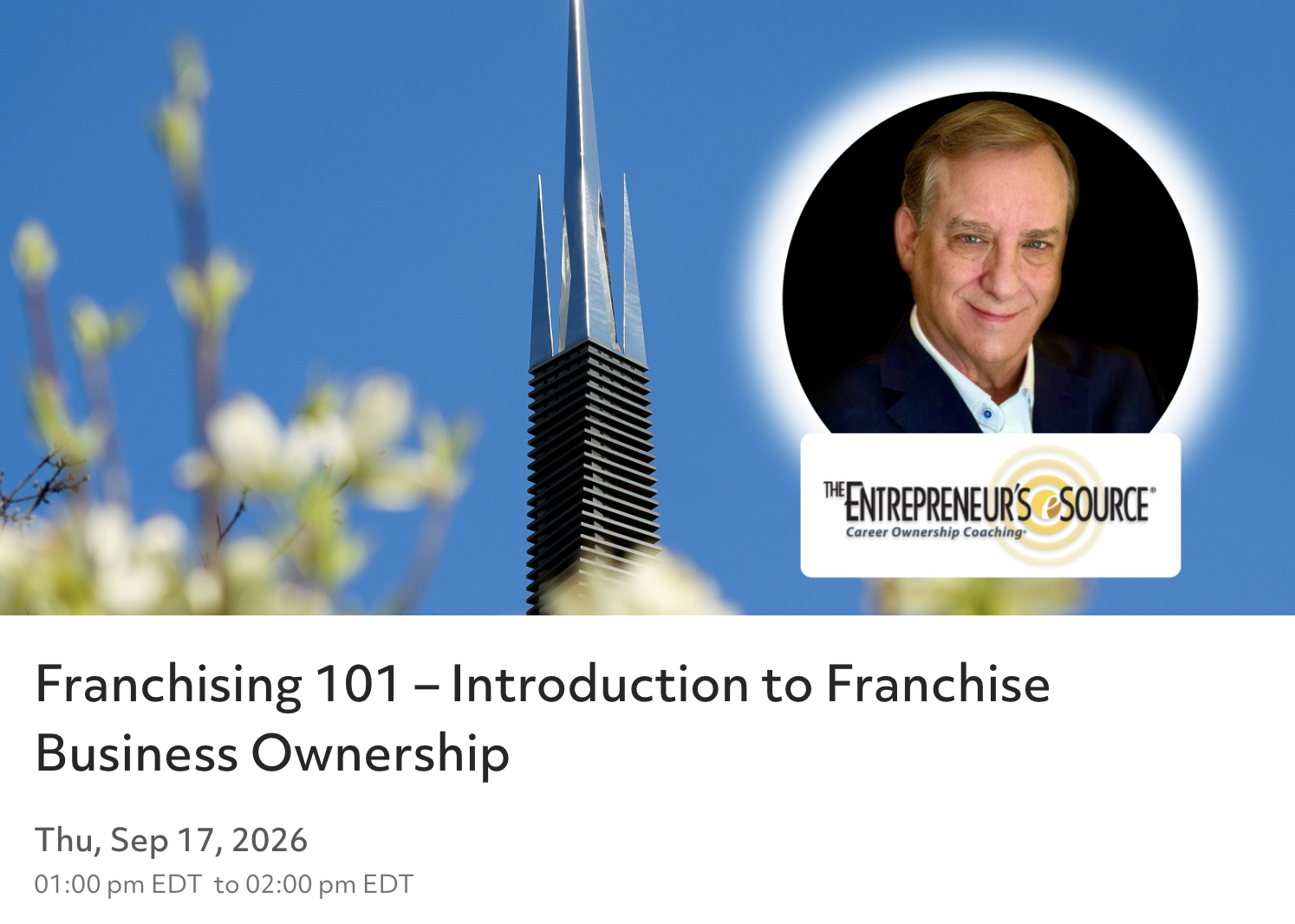
Franchise business ownership offers a proven, lower-risk pathway to entrepreneurship-providing an opportunity to run your own company without creating a concept from scratch.
For DETAILS and registration, click here: REGISTRATION LINK
Step back and the broader picture is just as striking. Roughly four million Americans now earn their primary income running a business by themselves, generating over $100,000 a year. That’s close to double the figure from the early 2010s.
Those numbers show what becomes possible with AI — not only how AI disrupts jobs. Tasks that once demanded a marketing hire, a bookkeeper, a developer, or a customer service team are increasingly things one person can manage with the right tools. The practical floor for running a real business has come down.
The “threat framing” misses the more useful question.
It’s true that productivity gains inside a job flow to whoever owns the company. Get more efficient as an employee, and the return lands on the company’s ledger. That isn’t unfair. That’s the definition of employment. OWN the business, and the same gain lands in your column.
But treating those productivity gains only as a job threat leads to the wrong conversation.
The more useful question isn’t “Will AI take my job?”
It’s “Does this change what’s actually available to ME?”
For a lot of people, the honest answer is yes.
Ownership options that would have required significant hiring, deep technical skill, or a decade of industry experience are more reachable now than they were three years ago.
That’s not a threat. That’s a widened field of possibilities — and most people have never taken a serious look at what’s in it.
Others are sensing the same thing. In the TES Generational Career Confidence Survey, 83% of Americans said they view business ownership as a viable alternative to a traditional career path. Eighty percent said ownership gives a person more control over their career.
On AI specifically, 61% said they believe business ownership is the best protection against a career being made obsolete — rising to 68% among Millennials and 65% among Gen Z.
Those are beliefs, not proof that ownership protects anyone from disruption. They do show that public opinion is moving in the same direction as the Stripe data.
But is being a solo entrepreneur actually good for you?
Here’s where the headline numbers deserve a harder look.
A million-dollar one-person company sounds extraordinary. Living inside one is a specific experience, and it isn’t for everyone.
It’s also worth keeping the scale honest. Thousands of million-dollar solo operators is a striking number and a small slice of the millions of businesses in this country, and Stripe’s platform skews toward digital and internet-native companies. Solo operation isn’t new either. Holly Wade of the National Federation of Independent Business makes a fair point: most small businesses have always started with one person, and the first five years bring a lot of churn. What AI appears to be changing is the ceiling on how far a solo operator can climb — not the odds that any given person should become one.
None of that argues against ownership. It argues for figuring out which version of ownership fits the life you actually want.
And if it is right for you, you don’t have to build it from scratch.
This is the part that gets lost in the solopreneur coverage. The choice isn’t between staying in a job and inventing a company from nothing.
Proven models already exist across dozens of industries — brand built, operations tested, training in place, and a network of owners who have already solved problems you would otherwise meet the hard way. You bring ownership, effort, and judgment.
You skip the years of trial and error that independent founders pay for in time and capital.
Within that world, the range is wider than most people expect. Some models are genuinely owner-operated and lean. Others are built to be managed while you keep your current income. Some are semi-absentee by design. Some scale into multiple locations and a real team; others are meant to stay small and profitable.
AI is reshaping operations across all of them, which means the economics of models you might have dismissed a few years ago may look different today.
The question was never whether you’re cut out to be a solopreneur.
It’s which form of ownership, if any, fits your income needs, your schedule, your risk tolerance, and what you want to have built in ten years.
How Do You Find Out Which Version Fits?
Most people never run that exercise. Not because they aren’t capable of it, but because there’s no obvious place to start, and browsing opportunities alone is a fast route to overwhelm.
That’s the work I do – in collaboration with you. The process starts with you: What you need to earn, how you want to spend your days, what you’re building toward, and what you’ll own at the end of it. Those four questions come before any conversation about specific opportunities. Only then does the work move to which options in the market actually match.
Ready to explore? Reach out. I help people run that exercise every day — and I’m using these same tools in my own business!
To your success!
Julian Reid